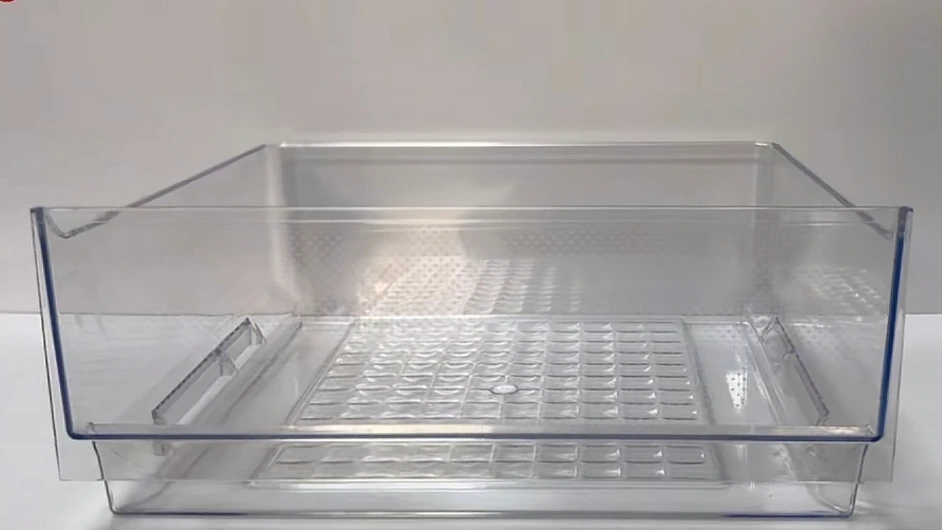
Today we met our Mexican customer. There were three of them, one more than the last visit. In terms of business, they placed an order with us for a refrigerator drawer mold, and we also learned that they placed a similar product order with our sister mold company.
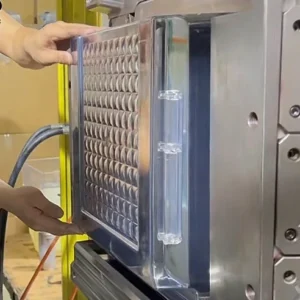
At noon today, the customer came to inspect the first trial run of the refrigerator drawer mold. During the trial, the injection-molded parts showed issues including cold slug, drag marks, shrinkage, part cracking, and low surface gloss on certain areas. After identifying these problems, we shortened the ejector rod stroke of the injection machine and increased the mold temperature to observe whether the cracking and shrinkage issues could be resolved. Fortunately, we were able to mitigate the shrinkage issue and solve the part cracking problem. For other issues such as cold slug and surface gloss, we plan to address them by adjusting the lifters and further polishing the mold.
In the afternoon, we conducted a trial run on another product. Considering that we needed to manually remove parts from the injection machine for inspection to prevent them from being too hot, the lower mold temperature indeed made it easier for us to take out the parts. However, the downside was obvious: there were weld lines on the product. To troubleshoot the issue, we first performed a short shot test on the mold using the injection machine. We observed that there were three flow fronts at the weld line area, which allowed us to rule out machine parameter issues and confirm that the weld line was caused by the mold itself. Then, without modifying the mold, we tried to eliminate the issue. We stopped considering the issue of hot parts and increased the mold temperature in an attempt to remove the weld lines. Fortunately, the problem was solved. Based on the high-volume nature of this part, we infer that in mass production, the mold temperature will be higher and the injection speed will be faster, and the weld line issue will be completely resolved.
There was also a small incident today. During the trial of the second mold, we found that the slider stroke was insufficient, indicating a structural issue with the mold. We removed the slider stop screw and manually moved the slider during mold opening. Since the customer required a large number of samples, our project specialist had to manually operate the slider many times—each cycle required moving the slider twice. Due to the slider direction issue, we even had to use a small aluminum hammer to tap the slider to make it move smoothly. Because of this, the project specialist was extremely exhausted from manual operation and directly called the mold designer responsible for this mold to come over and manually unlock the slider. He performed it about four times. Our designer reluctantly said he was very tired and still had other tasks, but the project manager reluctantly agreed. In order to keep the project on schedule, he had no choice but to continue operating there manually. Haha, a truly qualified injection mold designer is really important, as it can reduce a lot of follow-up issues.
Choose NAVIMOLD—problems only appear in the process, never in the final result. And even if they do appear in the result, we will solve them through our global office network.